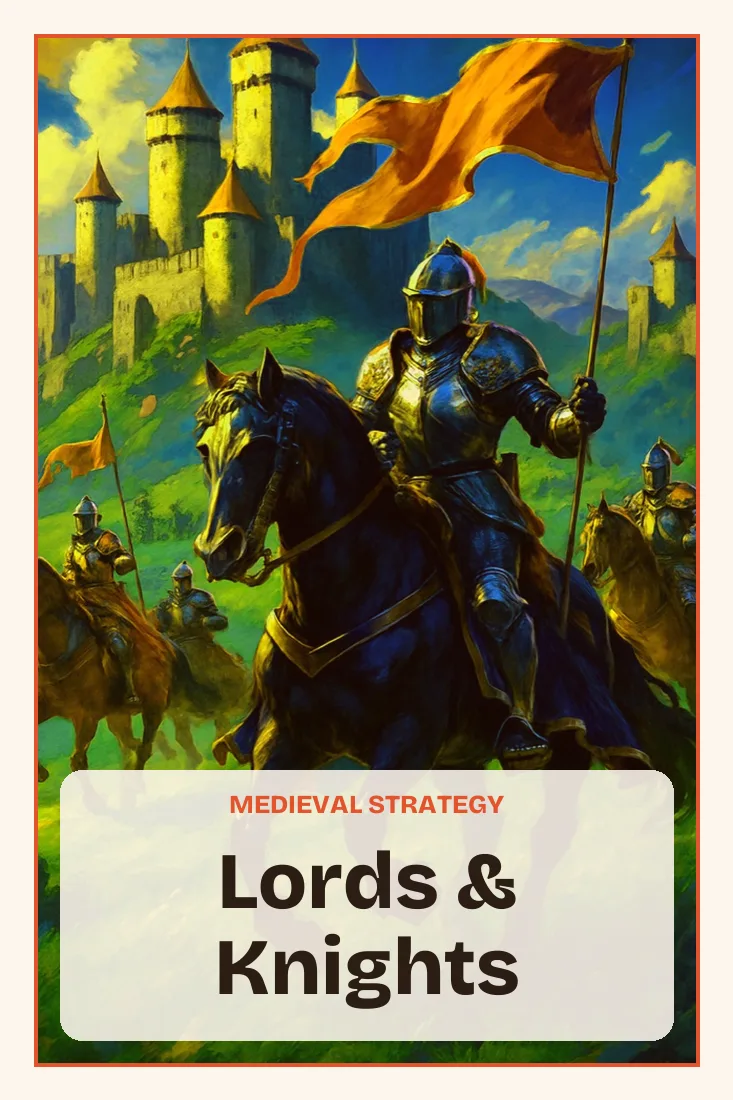
Lords & Knights starts with the most traditional premise on our shelf: you take control of one castle and its knights, and the long-term aim is to expand that realm all the way to an empire. What makes it distinctive is not the premise but the shape of play. Its developer, Xyrality GmbH, made a game that feels designed for the phone in your pocket as much as the browser on your desk, and that changes how a campaign fits into a week.
The game’s own page describes it as available for browser, iOS and Android, and we used all three during our month. Routine work happens in moments: a building queued while the kettle boils, resources sent between castles on a lunch break. The serious work happens inside an alliance, which is where Lords & Knights shines brightest. Ours had hundreds of members and a surprisingly disciplined chain of command.
From a simple keep to a fortress
Your starting castle is plain, and the early game is about improving it steadily: production buildings for resources, storage in your keep to protect them, and fortifications that make you an unattractive target. The research system lets you discover new technologies that improve defences and production, and choosing the order matters more than speed, because each discovery shapes what you can build next.
As the realm grows, castles can become fortresses and the map fills with larger strongholds. That progression gives the mid-game a clear sense of direction. You are always working toward the next tier of stronghold, and the game does not pad that path with distractions. It is lean, readable and very easy to pick up again after a day away.
Missions, trade and a quieter road to growth
Not every useful action involves an army. Lords & Knights includes missions that send your units on errands such as driving off robbers, taking part in a joust or holding a castle festival in honour of your empire. They are a pleasant way to put idle troops to work and they give the game a touch of medieval colour that the purely military realms lack.
Trade between castles and with allies is the other peaceful lever, and it becomes more important as your realm spreads. The game frames itself as a mix of peaceful diplomacy and well-planned conquest, and in our experience the best players were the ones who did both: kept the economy humming through missions and trade, then committed fully when the alliance called a campaign.
Alliances of hundreds and the art of the timed attack
Alliances are the core of Lords & Knights. You can found one or join an existing one and plan the strategy of a medieval empire with hundreds of other players, and on a busy world that is not an exaggeration. Our alliance coordinated attacks on enemy cities by agreeing arrival times in chat, so that several members’ armies would land together. Getting that right felt like conducting an orchestra.
That coordination is also where the game asks the most. Big operations are scheduled, and if the alliance plans one for a time that suits Europe, a player in British Columbia may be setting an alarm. The best alliances share the load across time zones. The worst expect everyone online at once. Choose accordingly; it makes more difference here than in any other game on our list.
Why the phone version matters so much
In most castle games the app is a convenience. In Lords & Knights it feels like the main venue. Menus are compact, reports are readable on a small screen, and the routine of queuing builds and sending troops takes a minute or two. For anyone whose days are fragmented, this is the realm most likely to survive past the first month, because it never asks you to find an hour.
The trade-off is visual and tactical depth. Battles are about numbers and timing rather than spectacle, and the presentation is functional rather than grand. We did not mind. The excitement in Lords & Knights comes from the alliance chat lighting up at the right moment, not from the art, and the design understands that perfectly.
Laying foundations in Lords & Knights
- Install the app and the browser version, then decide which handles your routine checks and which handles planning.
- Prioritize production and keep storage, so resources survive between your short visits.
- Start research early and follow a clear path toward better defences before chasing offence.
- Send idle units on missions rather than leaving them waiting in the castle.
- Join an alliance with members in North American time zones, and ask how it schedules big operations.
What wore on us
- Presentation is functional, and battles have little visual drama.
- Alliance operations scheduled for European evenings can mean very early alarms in Canada.
- Building variety is narrower than in the bigger castle builders on our shelf.
What kept us logging in
- Short, efficient visits make it the easiest realm here to keep alive for months.
- Missions such as jousts and castle festivals add charm beyond pure warfare.
- Alliances with hundreds of members make coordinated attacks genuinely thrilling.
- The path from simple castle to fortress gives the mid-game a clear direction.
The ruler who will thrive in Lords & Knights
Commuters, parents and anyone with a fragmented day who still wants a real war with real allies. It suits players who enjoy coordination and chat more than visual spectacle, and who prefer lean menus to sprawling ones.
Where Lords & Knights stands after a month
Lords & Knights is the realm most likely to still be on your phone in the spring. It keeps the castle-and-conquest formula lean, adds missions and trade for gentler days, and saves its real excitement for alliance operations that involve hundreds of players. Its looks are plain and its building list modest, but for alliance life it is as good as anything here.