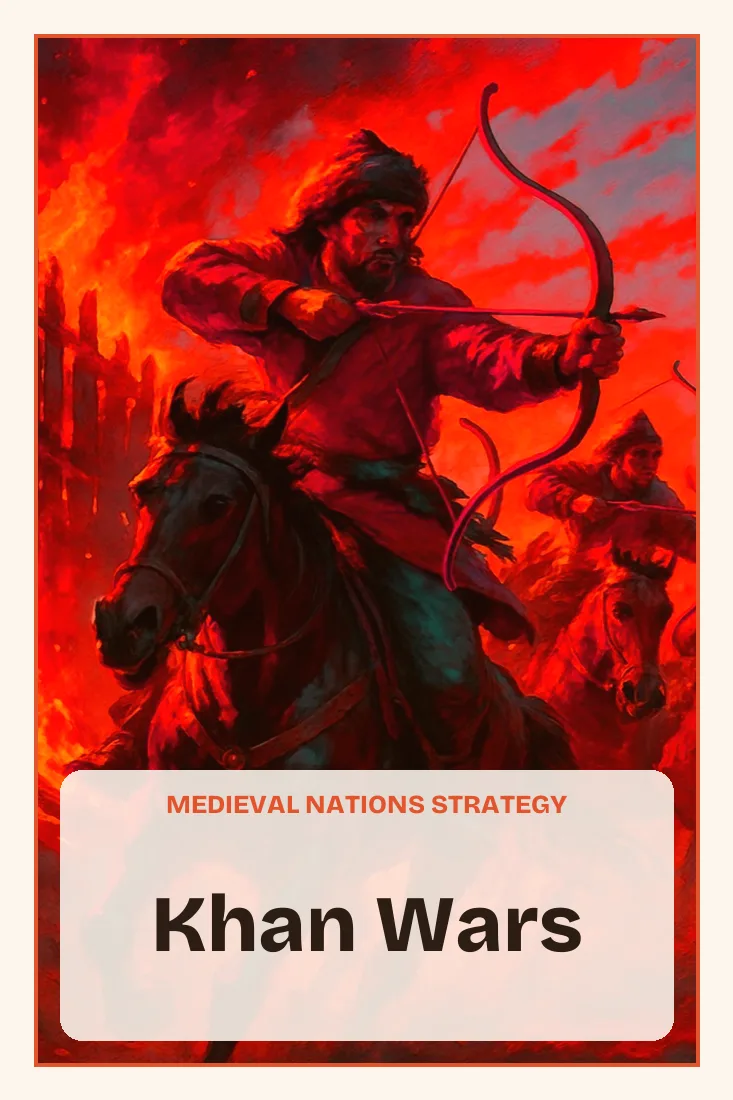
Khan Wars is the kind of game that tells you its history in the footer: XS Software dates its copyright line back to 2005, and the studio describes itself as a pioneer of early browser-based gaming. Log in today and the world list is very much alive, with different worlds running at different speeds. It is not flashy. It is, however, one of the more thoughtful war games we played, and the reason starts before your first building goes up.
Every account begins with a choice of nation, and that choice follows you for the life of your empire. We played in a desktop browser and checked in on the app during the day. Over a month, Khan Wars rewarded the planning we put into that first decision more than any opening choice in the other five games, and it made our guild’s citadel campaign feel like a genuine campaign.
Twelve peoples, three kinds of advantage
The game offers twelve nations and describes them as well balanced, each with a bonus that affects your economy, your battle strength or your trading. That sounds like a menu choice, and for a day it feels like one. Then you notice how the bonus quietly shapes everything: whether you lean into raiding, build a merchant network, or invest in a stronger home economy and let others come to you.
Nation-specific units unlock as you progress, so the choice also defines part of your army later on. We picked a nation with an economic edge, which made our first fortnight comfortable and our first war harder. A colleague chose a combat bonus and had the opposite experience. Neither was wrong, and the fact that two reviewers could have such different months in the same game is a strong point in its favour.
Twenty-eight units and the spy before the sword
Khan Wars lets you recruit up to 28 different units across infantry, archers, cavalry, siege machines and the nation-specific specials, and those troops can be enhanced to boost their attack and defence. The game describes its battle system as built around tactics, with a great many possible approaches, and the claim holds up in the sense that army composition genuinely matters.
Spying is the habit that separates good players from busy ones. Sending scouts to learn what a target is holding before committing an army saved us repeatedly, and skipping it cost us a full cavalry wing once. The rhythm of spy, plan, then strike gives even small engagements a sense of method, and it suits players who would rather think than click quickly.
Guilds, citadels and holding the map
Guilds are where Khan Wars becomes a long game. Under a guild leader, members can conquer citadels, control territory on the map and extend the guild’s power together, and the real-time guild chat is where all of that gets organized. Our guild ran citadel pushes on weekend evenings, which neatly matched the hours when members from Halifax to Calgary were all free.
Holding territory gives the guild a reason to exist beyond mutual defence. It means rotas, reinforcement plans and arguments about which citadel is worth the effort, and a solo player will miss most of what the game is about. If you do not want a guild, Khan Wars is still playable, but it is much less interesting.
Choosing a world speed that fits your life
When we checked the login page, worlds were listed with different speeds, including 2x, 5x and 10x. This is one of the most useful choices the game gives you and one of the easiest to get wrong. A fast world compresses months of growth into weeks and asks for frequent visits; a slower world forgives a missed evening and plays out over a longer season.
Our advice is to match the world to your week rather than your impatience. We found a slower world ideal for the economic nation we picked, while the colleague on a faster world needed to check in several times a day to keep pace with the raids. Both experiences were good. Only one of them fit around a full-time job without strain.
Laying foundations in Khan Wars
- Read all twelve nation bonuses before choosing, and pick the one that matches how you actually like to play.
- Choose a world speed that fits your weekday hours, not the fastest one on the list.
- Build economy and storage first, then a small mixed defence of infantry and archers.
- Send spies to every target before your first attack, and keep the habit once it pays off.
- Join a guild that already holds territory, and ask which citadel campaign it is planning next.
What wore on us
- The interface feels dated compared with newer realms on our shelf.
- Solo players miss most of the game’s best content.
- Fast worlds can demand more check-ins than a working week allows.
What kept us logging in
- Twelve nations with distinct bonuses give every account a real identity from day one.
- A roster of up to 28 units, including nation-specific specials, keeps armies varied.
- Spying before attacking turns raids into a methodical, satisfying routine.
- Guild citadel campaigns give long-term players a shared goal on the map.
The ruler who will thrive in Khan Wars
Strategists who like an opening decision that matters, players drawn to guild-level territory wars, and anyone who prefers a methodical spy-then-strike rhythm. Not the right choice for those who want polished visuals or prefer to play entirely alone.
Where Khan Wars stands after a month
Khan Wars has the most meaningful first decision of any game we reviewed, and its nations, deep unit list and guild citadel campaigns make it a strong home for months. The menus are plain and solo play is thin, which keeps it out of the top two. Pick the right nation, pick a world speed you can live with, and find a guild that holds ground: it rewards all three.